
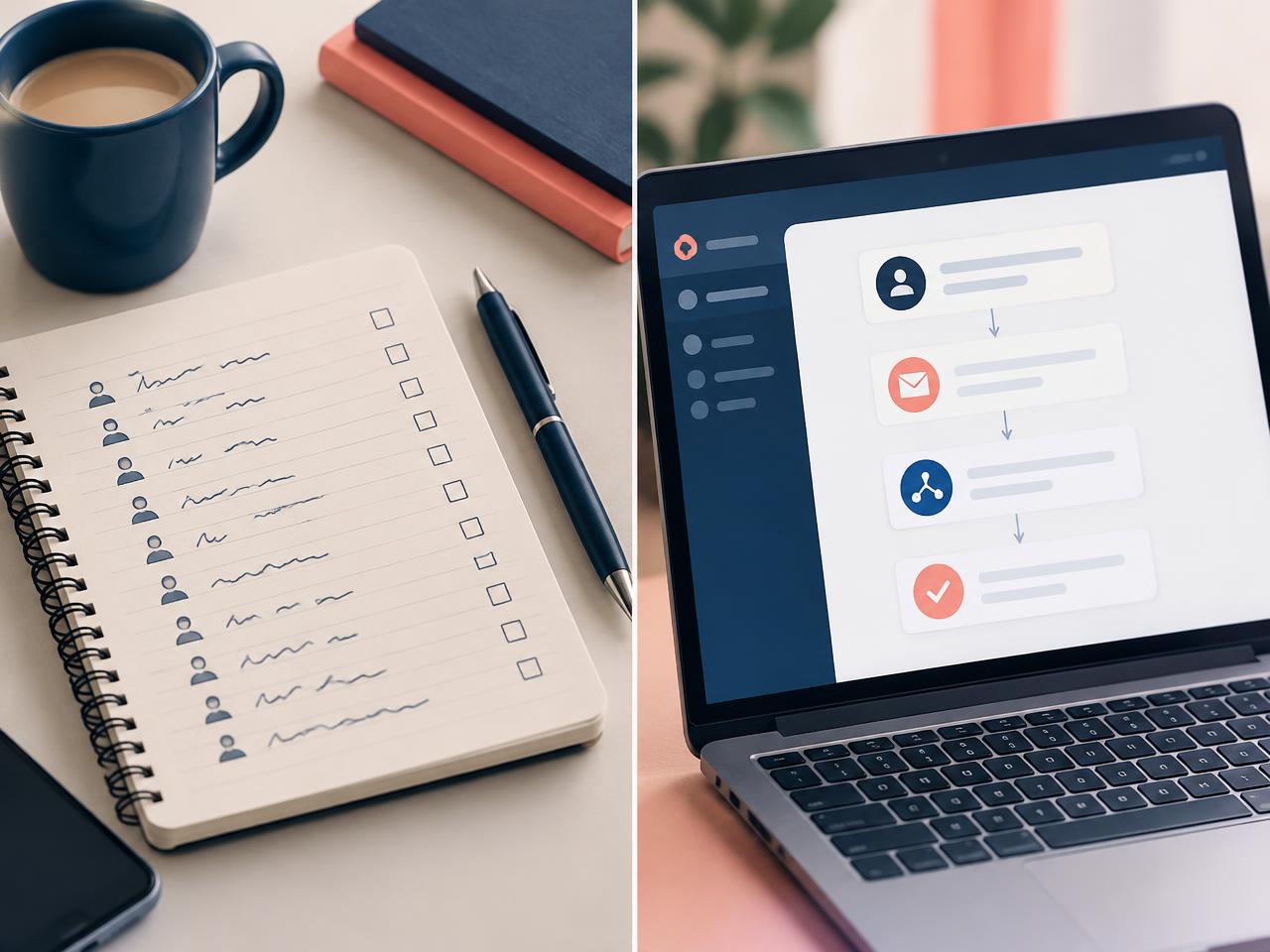
The short answer
Compare manual Google review requests with automation for cost, control, consistency, compliance and customer experience.
- Manual works when volume is low and the team is consistent.
- Automation helps once eligible follow-ups get missed.
- Neither guarantees a number of reviews.
01At a glance
| Question | Manual requests | Automated requests |
|---|---|---|
| Initial setup | Minimal | Workflow and template configuration |
| Ongoing effort | Staff must remember each request | System handles defined eligible events |
| Personal touch | Naturally individual | Can be personalised with approved data |
| Risk of forgetting | Higher without a checklist | Lower when triggers are reliable |
| Error risk | Wrong link or missed customer | Wrong trigger, duplicate or opt-out error |
| Cost | Staff time | Subscription, messaging and setup |
| Best for | Lower volumes, unusual projects | Repeatable, higher-volume services |
 Related guideWhatsApp Google Review Requests: How to Ask Without Sounding Pushy
02When manual requests work well
Asking customers for reviews manually is simple and personal. Automating invitations can make the process more consistent, especially when a business handles many completed jobs. Neither approach is automatically better, and neither guarantees more positive reviews.
The right choice depends on your customer volume, staff workflow, communication permissions and willingness to maintain a system.
If you run a boutique consultancy completing a few projects each month, a personal email after a project may be all you need. You know each client and can choose an appropriate moment to invite feedback without installing another system.
Manual requests also work for businesses that do not maintain reliable completion records. A simple weekly checklist can be more dependable than a poorly configured integration. Use the Google review link guide and request templates to standardise the process.
03Where manual requests break down
As a team grows, responsibility becomes unclear. One employee assumes another has asked. A job is completed late on Friday and nobody follows up. Staff use different wording or the wrong location link. Reporting becomes guesswork.
The issue is rarely that staff don't care. It's that review invitations are a small task competing with urgent customer work. If the process depends on remembering, inconsistency is predictable.
04What automation changes
A well-designed workflow uses a reliable event, such as job completed, checks whether a customer is eligible and sends an appropriate invitation through a permitted channel. It can also apply frequency limits and create a record of what happened.
Automation does not mean every customer receives the same message at the same time. Timing can reflect the service. It also does not mean writing or posting a review for a customer, which would undermine authenticity.
05Automation introduces different risks
Incorrect triggers: A booking may be cancelled, rescheduled or never attended. Poor contact data: A message could go to the wrong person. Over-messaging: A repeat customer may receive too many invitations. Consent problems: Having a phone number does not necessarily authorise promotional or review-request messaging. Misleading measurement: A sent request is not a published review.
These risks are manageable, but only if the provider and business agree on clear operating rules.
06A practical break-even calculation
Suppose staff spend three minutes per manual request and the business sends 100 requests monthly. That is five staff hours. Multiply by the relevant fully loaded hourly cost to estimate manual labour. Then compare software and messaging charges plus the time needed to maintain the automation.
This is a time-cost exercise, not a guarantee that automation generates more reviews. It also assumes your manual timing estimate is realistic. Track it for a week rather than guessing.
07Three real-world decision scenarios
A small trade business: 15 jobs monthly
A direct review link and a personal message may be enough. If the owner already uses a job-management system, a simple automation could still be convenient, but it is not essential.
A cleaning company: 200 jobs monthly
With many repeatable completion events, automation may prevent missed invitations. The business needs duplicate suppression, appropriate customer contact permissions and rules for repeat bookings.
A five-branch automotive business
Consistency across branches becomes more important. Each branch needs its own review link and reporting. Automation can help, but location-specific permissions and governance matter as much as message sending.
08The hybrid approach is often best
Use automation for straightforward, eligible customer interactions and retain manual control for sensitive or unusual cases. Staff should be able to pause requests, correct a customer record and handle complaints independently of the review workflow.
A hybrid process also gives managers a chance to review opt-outs, delivery failures and customer feedback without manually composing every message.
09How to choose in 30 minutes
- Count your completed customer interactions last month.
- Estimate the time spent on manual invitations.
- Identify a reliable completion event.
- Check your contact permissions and opt-out process.
- Decide whether reporting by employee or location matters.
- Compare the full cost of software and messaging.
- Pilot the chosen approach and monitor customer experience.
10Choose the simplest reliable process
If manual requests are working, keep them. If your team regularly misses eligible follow-ups, explore a controlled automation workflow. See how Ranknua handles review requests and compare current plans.
Frequently asked questions
Is automation against Google's rules?+
Automating invitations for genuine, unbiased reviews is not inherently prohibited. Incentives, selective solicitation of positive reviews and review manipulation are prohibited.
Will automation improve my star rating?+
Not necessarily. Customers decide whether to review and what rating to give. Consistency in invitations is not a guarantee of positive feedback.
Can I automate requests without a booking system?+
Some tools support manual completion inputs or alternative triggers. Verify how the particular platform works.
Should every customer receive a reminder?+
No. Reminders must respect permissions, frequency limits, opt-outs and the customer's circumstances.
Sources
General guidance, not legal advice. Google’s features and rules change; check the linked pages.